Why Isometric Maps Work for Woodland Garden Planning
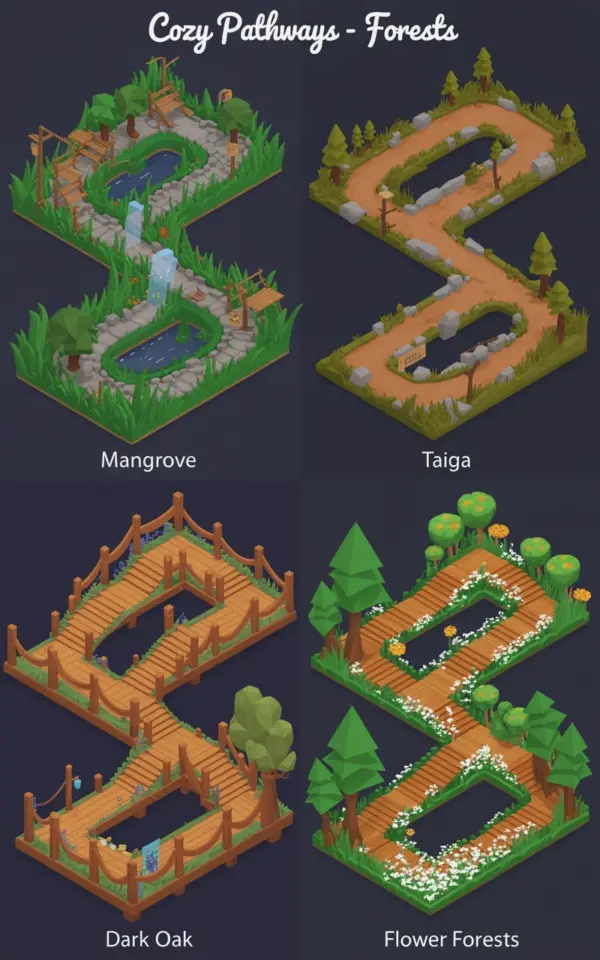
If you have spent any time scrolling Pinterest for trail ideas, you have probably noticed the rise of isometric map visuals. They take a bird’s eye concept and add depth, making it easier to imagine how a forest garden path might actually feel on the ground. The photo for this article shows exactly that: a clean grid with four distinct biome layouts, each offering a different mood. I find these maps particularly useful because they force you to think about spacing, elevation, and material transitions all at once.
Instead of just picking a random winding line, you can visualize how stone meets dirt meets wood, and how trees and water fit into the flow. That is the kind of clarity that saves you from digging up a pathway twice. Whether you are planning a small backyard trail or a larger woodland retreat, starting with an isometric sketch gives you a playbook you can actually follow.
Mangrove Biome Pathway Layout: Stone and Water Elements
The top left corner of the map is labeled “Mangrove,” and it immediately caught my eye. A winding stone path snakes through dense green vegetation, punctuated by small water features and wooden structures. Mangroves in nature thrive at the edge of water, so this layout is perfect if you have a low, damp area in your yard or want to introduce a small pond.
For a real garden, you can replicate this by using irregular flagstones set into a bed of creeping thyme or moss. Keep the path slightly raised above the ground level, so it stays dry even after rain. The wooden structures in the map (small boardwalks or bridges) can be built from pressure treated pine or cedar, which holds up well in moist conditions. If you do not have actual water, use a dry creek bed with pebbles to mimic the look.
- Recommended materials: flagstone, river rock, cedar planks.
- Best for: shaded, moist areas near a water source or rain garden.
- Plant pairing: ferns, hostas, marsh marigold.
Taiga Biome Design: Dirt Paths with Natural Stone Accents
Moving to the top right, the “Taiga” map shows a brown dirt path with scattered stone elements and clusters of conifer like trees. This layout feels more rugged and low maintenance, ideal for larger properties or sloped sections where you want a natural look without high upkeep. Dirt paths drain well and soften over time, but they can get muddy in heavy rain.
To improve durability, consider mixing decomposed granite with the topsoil. This keeps the path stable while retaining that earthy, forest floor appearance. The stone accents in the map serve as both visual markers and practical stepping points on steeper sections. Place them at intervals where you naturally pause or change direction.
Taiga inspired paths work best with evergreen ground covers like juniper or low growing pines. If you live in a colder climate, this layout also handles snow melt better than solid stone, because the dirt absorbs moisture instead of creating icy sheets.
Dark Oak Biome: Wooden Walkways for Shaded Woodland Gardens
Down in the bottom left corner, the “Dark Oak” section features a wooden path that winds through a dense, shadowy canopy. The map shows wider planks and a more structured feel, which suits areas where you want a clear, deliberate trail through thick trees. Dark oak evokes the mood of old growth forests, with deep browns and greens.
For your own garden, use hardwood like ipe or black locust for longevity, or go with treated pine if you are on a budget. The key is to leave small gaps between boards for drainage and to let leaf litter fall through, keeping the surface cleaner. In the map, the path appears slightly elevated, which is wise for woodland gardens with roots and uneven ground.
I recommend adding a subtle curve every 15 to 20 feet to match the natural meander of a forest trail. You can also install low edging (recycled plastic or pressure treated timber) to keep the path distinct from surrounding mulch or soil.
How to Adapt These Isometric Layouts for Your Backyard
You might think these maps look like something out of a video game, but they are surprisingly practical. Start by printing out the photo (or a similar isometric grid) and tracing the approximate shape of your yard onto it. Then try overlaying each biome style to see which one fits your existing trees, slopes, and wet spots.
For a typical
#gardenpath #forestgarden #pathwaydesign #isometricmap #woodlandgarden
Leave a Comment