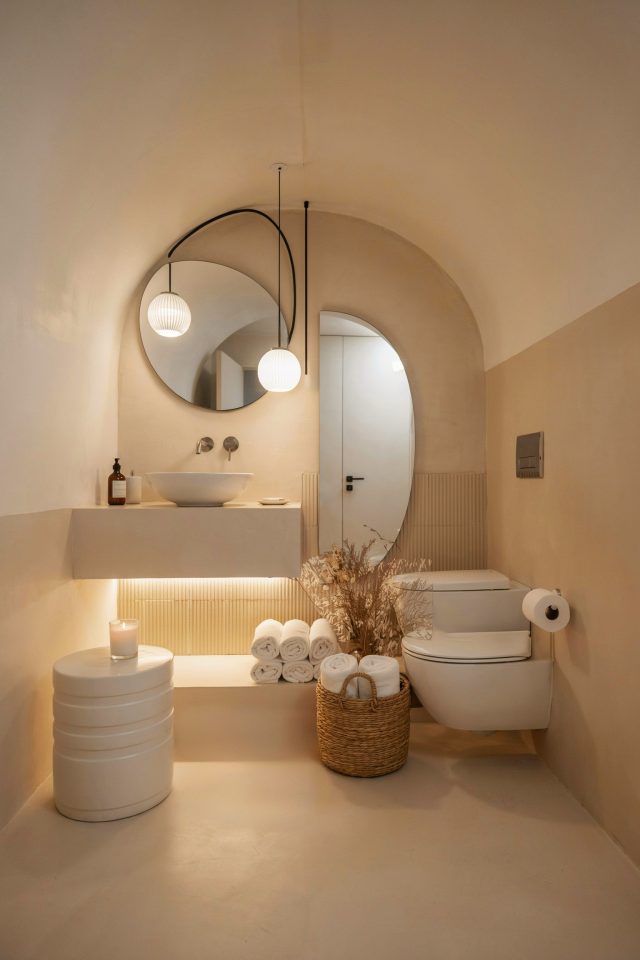
Why the Irregular Rounded Shape Fits a Small Half Bath
I have seen too many half bath makeovers where the toilet feels like an afterthought. A minimalist toilet niche with an irregular rounded shape solves that problem immediately. It turns a functional corner into a deliberate design feature. For small bathrooms, this shape does more than just look nice. It actually makes the room feel larger by softening harsh corners and guiding the eye around the space. The organic curve creates a gentle flow that straight walls and square alcoves cannot achieve. If you are short on square footage, this approach gives you a visual trick that adds depth without eating into your floor plan. I have used this in bathrooms as small as 18 square feet, and it always opens things up.
Mistake 1: Guessing the Clearance Space Around the Toilet
People rush into building a toilet alcove without measuring the actual clearance needed. A toilet niche that is too tight feels claustrophobic and makes daily use awkward. You need at least 30 inches of width for the toilet itself and another 15 inches of clearance on each side for elbows and movement. For the depth, the irregular rounded shape should leave at least 24 inches from the front of the toilet to any opposite wall. I once saw a half bath where the homeowner built the alcove 2 inches too narrow, and the toilet paper holder could not even open properly. That is a mistake you will curse every single day.
- Measure the toilet rough-in distance first (usually 12 inches from the wall to the center of the drain).
- Add at least 30 inches of width for the toilet and 15 inches of side clearance on both sides.
- Leave 24 inches of clear space in front of the toilet for standing and turning.
- Do not forget the door swing or pocket door track if you are using one.
Builders often forget that the irregular shape eats into the interior dimensions. A rounded alcove looks spacious in a drawing but cuts down usable width if you do not account for the curve. Always dry-fit a cardboard template of the toilet before you commit to the niche dimensions. That simple step has saved me from disaster more than once.
Mistake 2: Choosing the Wrong Tile Finish for the Niche
A toilet niche tile finish can make or break the whole minimal look. I see people pick high-gloss subway tile because it seems clean and modern. But in a small half bath with an irregular rounded shape, gloss tile reflects light in ways that highlight every imperfection in the curve. The shine also creates harsh glare points that distract from the organic form. Stick to matte or satin finishes for the niche itself. They absorb light softly and let the shape speak for itself. If you want some shine, use a matte tile with a subtle glaze rather than a full polish.
Another common issue is using oversized tile in a small curved space. Large tiles do not bend well into an irregular rounded niche. You end up with awkward cuts and excessive grout lines that ruin the smooth look you wanted. Use small-format tile like 2×2 mosaics or 1×3 brick shapes. These conform to the curve naturally and reduce the number of visible seams. The grout work becomes easier, and the final result looks like one continuous surface. I have also used thin brick tiles cut into narrow strips for a more textured feel. That works well if you want a rustic modern hybrid.
Do not forget about grout color. White grout on a dark tile looks busy in a half bath. Use a grout that matches your tile color as closely as possible. That keeps the eye focused on the irregular rounded shape instead of a grid of contrasting lines.
Mistake 3: Misunderstanding Warm Wood and Neutral Tiles
The Pinterest pairing of warm wood and neutral tiles sounds simple, but I have seen it go wrong in real bathrooms. People pick a wood tone that is too orange or too dark for the small space. Orange wood clashes with cool gray tiles and makes the half bath feel dated. Dark wood in a small room with a toilet alcove creates a cave effect that feels heavy rather than cozy. You want a wood tone that sits in the middle. Look for white oak, ash, or a walnut veneer with a matte finish. These woods have a neutral warmth that complements beige, cream, or soft gray tiles without fighting them.
Placement matters too. Do not cover every wall with wood. Use it sparingly as an accent on one feature wall or as a floating shelf above the toilet. The irregular rounded shape of the niche should remain the star. Keep the wood outside the niche and let the tile or plaster finish inside the curve stay clean and uninterrupted. I like to add a wood countertop on a small vanity or a wood ledge next to the toilet. That gives you the warmth without overwhelming the room. If you want wood inside the niche, use it only on the back wall and keep the sides tiled. That creates a contrast that highlights the curve.
One mistake I made early on was matching the wood stain to the floor without considering the undertones. The wood floor had a red undertone, and the tile niche had a green undertone. The result looked muddy and mismatched. Always bring tile and wood samples into the actual bathroom and look at them together under natural and artificial light. Your phone camera will lie to you. Look with your own eyes at different times of the day.
Mistake 4: Neglecting the Lighting Inside the Niche
A toilet alcove with an irregular rounded shape needs its own light source. I see people rely on the main overhead light and wonder why the niche looks flat and uninviting. The curve of the niche creates shadows that hide the shape and make the space feel smaller. You need a light that hits the back wall of the niche directly. A small recessed LED strip along the top edge of the curve works perfectly. It creates a soft wash of light that follows the rounded shape and makes it pop. You can also use a tiny wall sconce on one side if you have the clearance, but keep it flush or semi-flush to avoid bumping into it.
The color temperature of the light matters a lot. Warm white around 2700 to 3000 Kelvin works best with wood and neutral tiles. Anything cooler than 3500 Kelvin makes the space feel clinical. I recommend dimmable LEDs so you can adjust the mood. A half bath used by guests in the evening needs softer light than one used for morning routines. Put the light on a separate switch from the main overhead fixture. That way you can control the niche lighting independently. It sounds like a small detail, but it changes how the whole room feels.
Mistake 5: Treating the Niche Like Dead Space
People think a minimalist toilet niche is just a shape and nothing else. But a small half bath needs every inch to earn its keep. The niche can hold a few practical items without cluttering the look. I add a narrow shelf inside the niche at about eye level. The shelf is only 4 inches deep and made of the same wood or tile as the rest of the room. On that shelf, I place a small plant, a spare roll of toilet paper, and a tiny diffuser. That is it. Three items maximum. Anything more than that defeats the minimalist purpose.
The shelf should not break the visual flow of the irregular rounded shape. Use a floating design that mounts directly into the wall. If you want a cleaner look, skip the shelf and build a small recessed cubby into the side wall of the niche. That cubby can hold a phone or a reading material without disrupting the curve. I have also seen people install a shallow niche within the niche, a smaller indentation inside the larger one. That works if you have enough depth. Just do not overdo it. The goal is restraint. A half bath makeover succeeds when you choose what to leave out, not what to add.
Mistake 6: Overthinking the Organic Curve Construction
Builders and DIYers alike get intimidated by the irregular rounded shape. They think they need special tools or custom forms to create it. That leads to overcomplicated construction that costs too much and takes too long. The truth is simpler. You can create an organic curve with standard drywall and a flexible corner bead. Score the drywall on the back side every half inch, bend it gently, and secure it with screws. Use mesh tape and joint compound to smooth the curve. For tile, use small mosaics that bend naturally around the shape. You do not need a CNC router or a laser cutter. You need patience and a willingness to work slowly.
I have also used plaster or microcement directly over a wire mesh frame. That approach gives you a seamless finish with no grout lines at all. It works especially well for an irregular shape because the material becomes the shape. The downside is that plaster requires more skill to apply evenly. If you are not confident, hire a professional for that part. The rest of the construction is straightforward. Do not let the word organic scare you. It just means the curve is freeform rather than a perfect circle. That imperfection is exactly what makes it look natural and intentional.
One more practical tip: paint the inside of the niche the same color as the walls if you do not want to tile it. A painted niche with a rounded shape still looks minimalist and clean. Use a satin or eggshell finish that wipes clean easily. That approach saves money and reduces the risk of tile installation errors. I have done this in two of my own projects, and visitors always assume it is tiled. The smooth painted surface actually highlights the curve better than busy tile patterns do.
If you are planning a half bath makeover, start with the clearance measurements and the tile finish. Those two decisions will determine most of the outcome. The irregular rounded shape is forgiving if you keep everything else simple. Do not try to make the niche do too much. Let it be a quiet, functional feature that supports the rest of the room. That is the essence of minimalist design.
A minimalist toilet niche with an irregular rounded shape is one of those details that feels intentional without drawing too much attention. It solves the problem of a cramped half bath by adding visual space and a natural flow. Avoid the common mistakes I mentioned, and you will end up with a room that feels bigger than it actually is
#minimalisttoiletniche #halfbathideas #smallbathroomdecor #irregularrounded #toiletalcove
Leave a Comment