Why Most People Get Nighttime Garden Design Wrong
I see it all the time. Someone buys a beautiful fire pit, hauls it to the center of their yard, and calls it done. Then night falls and the whole space feels disconnected, like a random campfire dropped into a blank lot. That is the single most common nighttime landscaping mistake I encounter. And honestly, it is completely avoidable. The fix is simple: build the garden around the fire pit, not the other way around.
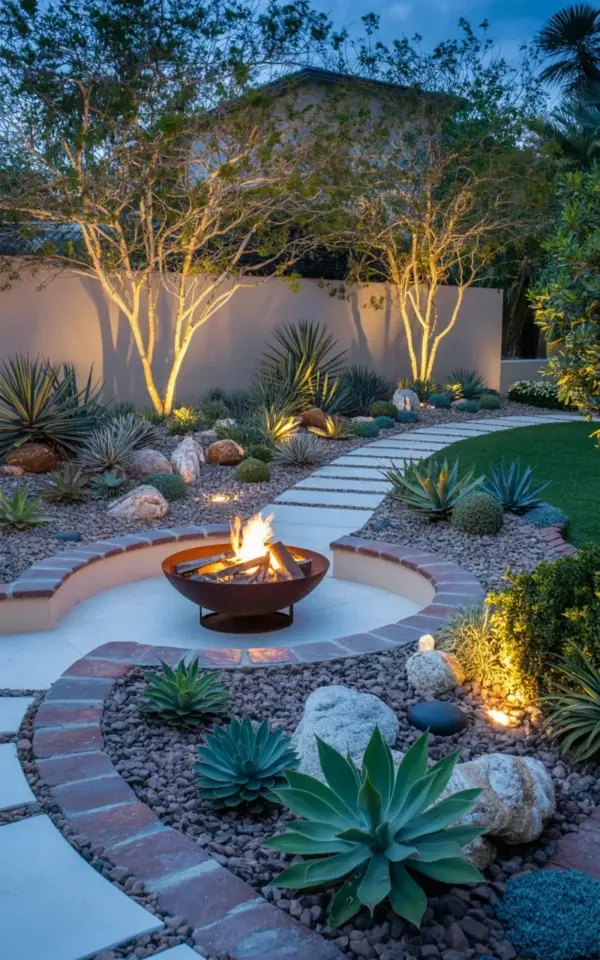
In the photo that inspired this article, the design does the opposite of that mistake. A circular fire pit sits at the heart of a planned landscape. Curved stone borders wrap around agave and succulents. White stepping stones lead your eye to a softly illuminated wall. Every element talks to each other. That cohesion is what makes a nighttime garden feel intentional, not just lit.
Here is the thing: fire pits are powerful focal points. But they only work if the rest of the garden bows to them, or at least acknowledges their presence. Dropping one down without considering the surrounding plants, paths, and lighting is like putting a chandelier in an empty room. Sure, it is there but nothing else makes sense.
Fire Pit Plant Layout Mistakes That Kill the Flow
Ok so the biggest blunder? Planting things that block the view of the fire from every seating angle. I have seen people stick tall grasses or dense shrubs right around the perimeter. Suddenly you are staring at leaves instead of flames. Not ideal.
Another mistake is ignoring how plants look at night. In daylight that green agave is gorgeous. After dark it can turn into a black hole unless you plan for reflective surfaces or silhouetted shapes. That is where succulents like blue agave shine literally. Their waxy leaves catch ambient light and bounce it back. The red-brown stone borders in the photo also help by providing contrast against the dark soil.
And please, for the love of garden design, do not plant anything flammable within 3 feet of the fire ring. I once tucked a creeping juniper too close and ended up with a smoldering mess. Learn from my singed pride.
- Keep tall plants at least 4 feet from the edge of the fire pit.
- Use low-growing succulents and groundcovers in the innermost ring.
- Choose plants with interesting nighttime silhouettes like agave rosettes or yucca spikes.
- Avoid plants that drop a lot of dry leaves or needles near the fire area.
Agave and Succulents: The Perfect Nighttime Duo
Look, I am not saying you have to go full desert landscape. But there is a reason agave shows up in so many fire pit garden photos. These plants are built for drama. The blue agave in the picture has that almost powdery blue hue that looks almost glow-in-the-dark under a soft moon or subtle landscape light. Pair it with darker green succulents and you get a layered texture that stays interesting even when the flames are low.
Succulents also handle the heat better than delicate perennials. A fire pit radiates warmth outward. Some plants will wilt or scald. Agave just shrugs. Plus, they require almost no water which means less maintenance. Seriously, I water mine maybe once a month during summer and they look like they are ready for a magazine spread. Not gonna lie, that kind of low-effort beauty is exactly what I want from a garden.
One weird detail: I have a particular love for the way agave leaves catch the orange light from the fire. The edges get this warm glow while the center stays cool blue. It is like nature’s version of a gradient filter. You do not get that with fluffy flowers.
Stone Borders and Stepping Stones: Creating a Path That Leads the Eye
The white stepping stones in the photo are not just decorative. They force your gaze to travel. Starting at the circular stone border around the fire pit, your eye follows those light-colored stones across the ground, one by one, until it arrives at the beige wall in the back. That visual journey is what makes a garden feel cohesive. Without it, the space is just a fire pit and a wall with some agave in between.
Curved, stone-bordered beds are smart because they soften the edge between the hardscape and the planted areas. Those reddish-brown stones in the image add warmth and echo the tones in the fire pit’s metal. A straight border would feel too rigid. The curve repeats the shape of the fire pit itself, tying everything together. See the pattern? Repetition of shape and color is how you avoid that scattered, mismatched look.
Stepping stones also serve a practical function at night. They guide foot traffic safely. You do not want guests stepping on your agave or tripping over a hidden rock. White or light-colored stones are visible even in low light. That is a simple smart choice.
Don’t Ignore the Background Wall or Fence
Here is a mistake I see over and over: people design the fire pit zone but leave the background completely dark and empty. In the photo, a beige wall with illuminated trees behind it provides a soft, glowing backdrop. That is not an accident. The wall catches reflected light from the fire and from the small uplights aimed at the trees. It turns a blank surface into a secondary source of ambient glow.
If your fire pit is up against a fence or a wall, consider adding a simple light wash. Even one small fixture at the base of a tree can change the whole mood. The goal is to create depth. Without a lit background, the fire pit becomes a bright spot in a void. With it, you get layers of light that make the garden feel bigger and more inviting.
And no, you do not need expensive professional lighting. A few solar uplights or low-voltage path lights tucked behind the agave will do the job. Just make sure the lights are aimed upward to highlight texture, not downward which can create harsh shadows.
How to Avoid the Common Mistake Step by Step
Alright, so here is my practical plan. First, mark the center of your fire pit location. Then draw a circle around it that represents the seating area. Now, step back and look at the whole yard. Where do you want people to walk? Where does the eye naturally drift? That is where the white stepping stones or a light path should go.
Next, choose your plants. Start with a ring of low succulents right next to the stone border. Then a ring of medium agave slightly farther out. Finally, a backdrop of taller plants or a feature wall. I like to lay out the pots on the ground before planting anything. Move them around until the arrangement feels balanced from every angle.
Then think about lighting. Place one or two small lights behind the agave to cast upward shadows. Add a soft light on the wall or fence in the background. And do not forget to test it at night before you finalize the planting. I once skipped that step and realized my favorite agave was completely invisible after sunset. Had to dig it up and move it.
Last thing: give the garden a few weeks to settle. Plants look different once they root in. The stone borders will shift slightly. You might need to adjust a stepping stone. That is normal. Nothing in garden design is truly done on day one.
So, next time you plan a fire pit layout, think of it as building a small world around the flames. Use agave and succulents for texture, stone for structure, and white stepping stones for a path that draws the eye. That is how you make a nighttime landscape that feels connected, not cobbled together. Save this idea for your next project. Your garden deserves a design that flows after dark.
#nightgardendesign #firepitlandscaping #agavegarden #desertlandscaping #outdoorliving
Leave a Comment