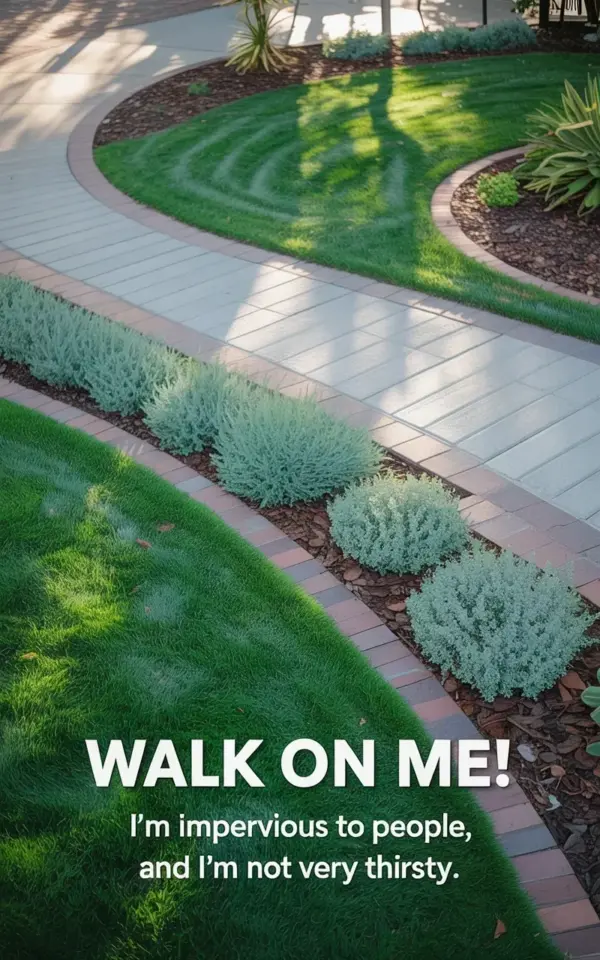
The light gray pavers curve through the yard like a lazy river, and honestly, the Russian sage is doing most of the heavy lifting. Budget garden path ideas don’t require a load of fancy stone or custom fabrication. This simple curved concrete walkway proves it: a sweep of vibrant green lawn, those silver-blue sage mounds, and dark brown mulch beds all working together without a single expensive material in sight. I’ve stared at this photo for way too long, and I’ve got thoughts. Let’s break down why this combo works, how to steal it for your own backyard, and where you can cut corners without losing the charm.
Why a Curved Concrete Walkway Beats a Straight One
A straight path is fine if you want to get from point A to point B with zero detours. But a curved concrete walkway makes you slow down. It invites a stroll. It hides the destination just enough to make the journey interesting. And here’s the practical part: laying a curve with standard rectangular pavers is actually easier than you think.
You don’t need special curved forms or precut stones. Just set your pavers with small gaps, stagger the joints, and let the grass fill in the spaces. The photo shows light gray pavers that look like they came right off a pallet at a big box store. Cheap, durable, and totally fine for a backyard path. My only advice is to level the base well. I once skipped that step and ended up with a paver that rocks back and forth like a loose tooth. Annoying.
Russian Sage and Dark Mulch: A Drought Tolerant Match
Let’s talk about the real star of this garden path ideas lineup. Russian sage isn’t actually sage. It’s a woody perennial with feathery silver-blue foliage that looks soft enough to sleep on. And it loves heat, hates wet feet, and doesn’t ask for much water once established. That makes it the perfect plant for a drought tolerant garden if you live somewhere with hot, dry summers.
Pair that with dark brown mulch beds and you get a serious contrast. The sage reads almost silver against the deep chocolate color of the mulch. The vibrant green lawn adds a third layer, so the whole scene feels rich but not busy. Honestly, the mulch is doing more work than people give it credit for. It keeps the soil moist, suppresses weeds, and makes the path look intentional instead of just dropped in the yard.
One thing I learned the hard way: don’t use the cheap dyed mulch that fades to gray in two months. Go with a natural dark hardwood mulch if your budget allows. It’s a small difference up front but a huge difference in how the garden looks by August.
How to Design a Curved Garden Path on a Budget
Here’s the thing about curves: they don’t cost more, they just require a different mindset. For a curved concrete walkway on a budget, you can use plain pavers and let the lawn or mulch fill the gaps. The curve itself comes from your layout, not from cutting expensive stone into weird shapes.
- Lay a garden hose or rope on the ground to map your curve before you dig.
- Use a sand or gravel base, not full concrete, unless you want a permanent monolithic slab.
- Keep the path width around 36 inches so two people can walk side by side.
- Forget expensive edging. Let the grass or mulch edge the path naturally.
- Buy pavers from a salvage yard or wait for a clearance sale, nobody can tell the difference after they’re laid.
The photo shows pavers set close to the grass, which means mowing right up to the edge. That can be annoying if the pavers are uneven. Trust me, I have a spot in my own path where the mower blade nicks a paver every single week and makes that awful screeching sound. So either leave a small gap for the lawn to grow into, or set the pavers flush with the soil line.
Mixing Lawn, Mulch, and Pavers for Better Backyard Landscaping
What makes this backyard landscaping idea work is the balance between three textures: smooth hard concrete, soft fine grass, and chunky organic mulch. You don’t need a huge garden or a professional designer to pull this off. You just need to give each element enough breathing room.
The lawn here isn’t just grass, it’s the negative space that lets the path and the plants shine. The mulch beds aren’t giant islands either. They’re tidy borders that hold the Russian sage and a few drought resistant shrubs. That’s it. No crazy perennial borders, no tropical plants, no fussy annuals. It’s almost boring, which is exactly why it works. A low maintenance garden that still looks great in June and again in September? Yes, please.
Ok so, one weird observation: the white text at the bottom of the photo says “Walk on me!” and underneath it starts “I’m imper…” probably “I’m imperfect” or “I’m important”, but I like to think it’s “I’m impervious.” Because honestly, a concrete path that survives sun, rain, kids, and lawnmowers deserves that title. Concrete might not be the most romantic material, but it has a thick skin. And that makes it perfect for budget garden path ideas that need to last.
Drought Tolerant Garden Ideas Straight From This Photo
Russian sage is the obvious plant here, but it’s not alone. The dark mulch beds are packed with small shrubs and other drought resistant plants that look good without constant watering. If you’re building a drought tolerant garden, think about layering textures: soft feathery foliage, stiff upright stems, and low mounded shapes.
Some plants that would fit right into these mulch beds include lavender, ornamental grasses, yarrow, sedum, and salvia. They all handle dry conditions and they all look good with dark mulch. The silver-blue tone of Russian sage, in particular, picks up the light in a way that makes the path feel cooler even at noon. I planted three of them last year and now I’m slightly obsessed. The bees love them too, which is a bonus since my tomatoes are always begging for more pollinators.
For the rest of the bed, keep things simple. Use a slow release fertilizer once in spring and then back off. Too much water will actually make Russian sage flop over and look messy. Let it be a little stressed. It’ll reward you with sturdier stems and a more compact shape.
What the “Walk on Me” Sign Tells Us About Garden Path Style
Some garden paths are purely functional. You use them to get from the back door to the grill without stepping in mud. But this one has a sign that says “Walk on me!” in big white letters, and that changes the whole vibe. It’s playful. It’s an invitation. It says this isn’t a formal garden, it’s a place to actually be.
Now, I’m not saying you need a custom sign with a snarky phrase on every path. But there’s something to be said for adding a personal touch, whether it’s a painted stone, a little metal animal, or just a weird collection of beach glass tucked into the mulch. It makes the garden feel like yours rather than a copy of a Pinterest photo.
Budget garden path ideas don’t have to be sterile. The photo’s sign is probably from one of those Etsy shops that laser-cuts metal and charges $40 plus shipping. You can recreate it with a stencil and spray paint on a piece of scrap wood for under five bucks. That’s the whole spirit of this backyard right there: save on the hardscape, spend a little time, and let the plants do the decorating.
So here’s the takeaway. You don’t need flagstone, brick, or expensive pavers to create a garden path that looks like a magazine spread. A curved concrete walkway, some Russian sage, a few bags of dark mulch, and a reasonable lawn can carry the whole design. Start small. Lay your hose out in the grass and walk that curve a few times before you dig. Buy the plainest pavers you can find. And for the love of good garden design, don’t skip the mulch.
If you’re planning your own backyard landscaping project, this is a solid, budget friendly blueprint to follow. Save it for later when you’re ready to get your hands dirty, and maybe add a cheerful sign of your own. I promise your path will know exactly what to do.
Leave a Comment