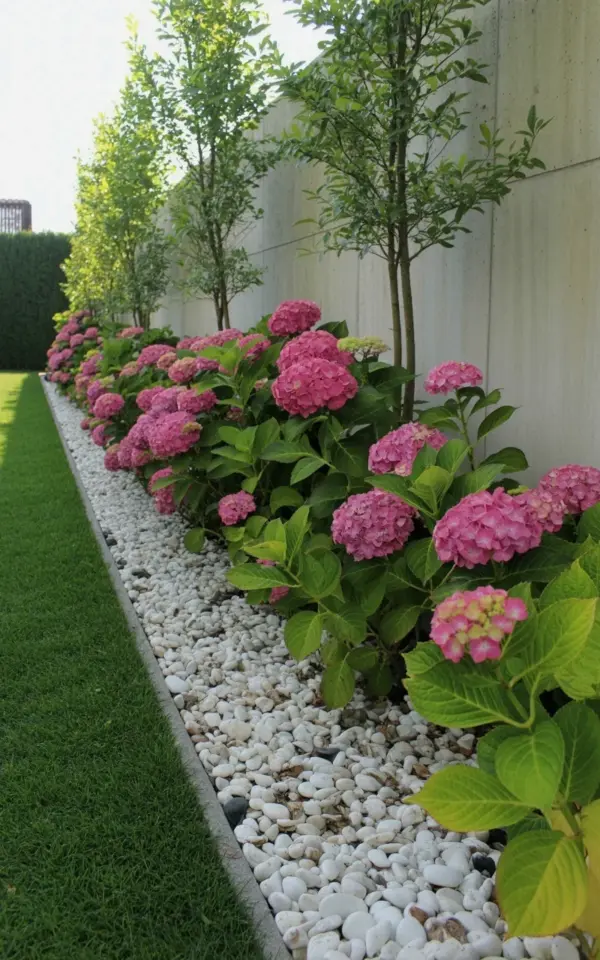
A two-foot strip of white river rock can completely change how a garden feels. In the photo that inspired this post, that strip runs alongside a wall of pink hydrangeas, and honestly, it looks like a secret path you would find in a countryside cottage. The contrast between the pale gravel and the saturated pink blooms is doing all the heavy lifting. It creates a garden path that feels intentional, cozy, and quietly luxurious.
What I love most about this idea is how simple it is to replicate. You don’t need a massive estate or a landscape architect. You need a wall, a border, some hydrangeas, and a load of white gravel. The result is a walkway that invites you to slow down.
### Why This Works as a Spring to Summer Transition Idea
We are moving into the season where gardens peak, and this specific setup is perfect for that in-between time. The bright green lawn in the photo is still fresh, not yet tired from summer heat. The young tree saplings behind the hydrangeas are all new growth and optimism.
Here’s the thing about hydrangeas, they take a moment to wake up. In early spring, they are just sticks. But by late June, those sticks are heavy with leaves and those big, rounded clusters of pink flowers. The white gravel path stays consistent throughout the year.
This means you get a beautiful, structured walkway even when the plants are dormant. Gravel does not care about frost. It does not wilt. That is a huge win if you live somewhere with unpredictable weather, it keeps the bones of your garden visible all year long.
### Choosing Hydrangeas That Give You That Perfect Pink
Not all pink hydrangeas are created equal. And I need you to hear me on this because it is a common source of heartbreak. The color of many hydrangea blooms depends on your soil pH. Acidic soil gives you blue. Alkaline soil gives you pink.
But look at the photo references we have. Those are large, rounded clusters. That is the classic bigleaf hydrangea (Hydrangea macrophylla). If you want that exact look, you need a variety that stays compact, like ‘Endless Summer’ or ‘BloomStruck’.
Another option is to cheat a little and get a paniculata variety like ‘Pinky Winky’. Those have cone-shaped blooms that start white and turn pink. They are not the same rounded shape, but they are incredibly reliable and way more forgiving if you accidentally prune at the wrong time. Honestly, you cannot go wrong either way. Just know the difference before you hit the nursery.
### The Gravel Path Needs More Thought Than You Think
Ok so, the gravel. In the image, the path is made of smooth, white river rocks of varying sizes. This is not the sharp, angular crushed limestone you might use for a driveway. This is the pretty stuff, the kind that makes a soft crunching sound under your boots.
There is a practical reason I like this choice beyond the looks. Smooth river rock does not compact down into a solid, muddy mass as easily as sand or decomposed granite. It stays loose and drains incredibly well. That is a massive advantage next to a wall, where water runoff can be an issue.
However, I must warn you about the maintenance. White gravel shows dirt. It just does. Leaves, pollen, and soil will wash into it and make it look dingy over time. You can slow this down by laying down a good quality landscape fabric underneath it.
You also want to think about the edge. That path needs a physical barrier, steel edging or large stones, to keep the gravel from migrating into your lawn. Otherwise, you will be picking rocks out of your grass every single week. It is a minor annoyance, but I’d rather put that upfront so you can plan for it.
### A Simple Breakdown of Your Gravel Options
If you are ready to commit to this look, here is what you should be shopping for at your local landscape supply yard:
– **Pea Gravel:** Classic choice. Small, smooth, and comfortable to walk on. It can shift underfoot, but that is part of the charm.
– **River Rock (1 to 2 inches):** This looks closer to the photo. It defines the path clearly. It is chunkier, though, so it is harder to shovel snow off if you live in a cold climate.
– **White Marble Chips:** These are brighter and more reflective. They pop beautifully against pink flowers but cost a bit more per yard.
– **Polar White Granite:** A modern take. It crunches very nicely and stays cleaner than other types because it is so hard.
### The White Wall Secret: A Blank Canvas for Color
Let’s talk about the white concrete wall in the background. That visual anchor is doing more for this garden than you might realize. It provides a blank canvas that makes the pink blooms absolutely screaming, in a polite, garden-way.
You do not need a white wall specifically. A light-colored fence or a tall hedge of green boxwoods can do the same thing. The point is that the backdrop is distinct from the path. In the photo, the gravel mirrors the wall, and the wall mirrors the gravel, creating a continuous ribbon of light around the bright pink flower clusters.
It is a clever optical trick. It makes the narrow, 2-foot wide walkway feel more expansive. It also allows the path to glow in the evening light, making your evening strolls feel a little bit magical.
### Practical Planting Tips and Realistic Expectations
Here is the part where I get a little bit specific and nerdy. Hydrangeas like morning sun and afternoon shade. If you plant them against a hot west-facing wall, that white wall will bake them. The leaves will scorch, and the blooms will fade to a sad, papery brown.
In the photo, the saplings are there to provide future dappled shade. That is a smart forward-thinking move. While the trees are young, you can plant your hydrangeas and enjoy the current conditions. In five years, the trees will be taller, and they will filter the harshest sunlight.
For spacing, give these beauties at least 4 to 5 feet of room. They get wide. If you plant them too close, you will be moving them in two years, and they will hate you for it. Also, water them deeply at the base, not from the top. Wet leaves are an open invitation for powdery mildew, which is not fun for anyone.
### Inviting the Cottage Garden Vibe Without the Chaos
This specific design is a departure from the traditional cottage garden chaos. Usually, cottage gardens are overflowing. They use tons of different flowers and textures, with lupines and delphiniums poking out everywhere.
This path is different. It is structured. It has one dominant plant hero, the hydrangea, backed up by a solid wall and a defined gravel line. The bright green lawn acts like a calm, breathing space.
If you want to lean into the cottage feel, I suggest adding a few soft companion plants at the base of the hydrangeas. A little bit of silver artemisia or some white alyssum would look great against the gravel. They are low-maintenance and will soften the hard edge of the path without stealing the show.
The ratio is everything here. Keep it to about 70% hydrangea, 20% greenery, and 10% accents. That way, you keep that clean, cozy look without it becoming a wild mess.
### Tying It All Together With a Few Little Nits and Grits
Not gonna lie, one thing that drives me mildly crazy about white gravel paths is the leaf cleanup in autumn. If you have saplings like the ones in the photo, you will be raking leaves out of those rocks for weeks. A lightweight leaf blower is your best friend here, just be careful not to blast the gravel all over the lawn. That is a rookie mistake, and you will know immediately when you hear the rocks hitting your window.
Another small thing I learned the hard way. The best time to lay this path is in the early fall, not the spring. The soil is still warm, but you are past the heavy spring rains that will wash mud into your fresh white stones. Plus, it gives the hydrangeas a winter to establish their roots before the next blooming season.
Anyway, aside from those small headaches, I am totally charmed by this idea. The combination of the pink hydrangeas, the white gravel path, and that bright green lawn is just pure visual comfort. It is a quiet, welcoming space that you will want to use every single day.
Would you plant these on the left side of your path or the right? I think I would mirror the photo exactly, but let me know what your garden layout looks like. If you are planning a similar project, take a screenshot of this post or save it to your landscaping board for later. The season goes by fast, and a little planning now means a dreamy walkway later.
Leave a Comment