The most well-meaning backyard makeover fails the moment you realize the only footprints in the perfect play area belong to the mailman. You built the sturdy swing set, arranged the pretty bins, and placed the cushions just so, but your kid took one look and went back to digging holes by the fence with a plastic spoon. Kids outdoor play area ideas are everywhere, but most of them are designed for adult eyes first and small humans second. That is the trap.
Here’s the thing: children do not see a yard the way we do. They see a giant, unstructured playground full of potential, but they won’t explore it if the space feels precious or complicated or just plain boring to touch. The trick is to build zones that scream “come mess this up,” not ones that whisper “please look at me from afar.” So, let’s talk about what actually works, based on real kid behavior and not just catalog photos.
Build a Shady, Squishy Reading Nook They Won’t Want to Leave
Sun is the enemy of outdoor play. Not because kids hate warmth, but because a blazing-hot slide or a baking plastic playhouse is physically miserable. You need a spot that offers natural shade, and not just from a tiny umbrella.
Grab a sturdy pop-up canopy or plant a fast-growing tree like a maple, then throw down some old picnic blankets or a cheap outdoor rug. Pile up pillows that you do not care about. Honestly, the more layers and textures, the better. Kids love to burrow.
Put a small crate of books and maybe a few toys that are only allowed outside in this specific spot. It gives them a reason to stop running wild and just exist outside for a minute. When kids control the space, they will use it. When you curate it for a magazine, they will avoid it like a dentist appointment.
Loose Parts and a “Junk” Zone for Open-Ended Play
Here is the mistake parents make: buying the complete plastic playset and expecting it to hold attention for years. Kids get bored with static equipment. The stuff that gets used daily is the stuff that moves, transforms, and can be smashed together in weird ways.
Create a designated corner for loose parts. A big plastic tub or an old wheelbarrow filled with:
– Wooden planks and PVC pipes (great for building ramps)
– Old sheets and rope for fort making
– A random collection of buckets, scoops, and oversized cardboard boxes
– Pinecones, large stones, and sticks
Honestly, my own kid ignored the expensive sandbox for a month and spent three hours stacking scrap wood against the garage wall to make a “dog elevator.” You cannot plan that. You just have to provide the materials and let their weird little brains do the heavy lifting.
A Mud Kitchen or Water Table That Survives the Mess
Look, the Instagram ones with the perfectly painted cabinetry and the copper faucet are lovely. But they are grown-up fantasies. The reality is a plastic table or an overturned crate works just as well, maybe better, because there is no pressure to keep it clean.
Set up an area that is dedicated to water and dirt. If you have a patch of bare soil, perfect. If not, put a cheap kiddie pool down to contain the apocalypse. Add some old pots, pans, and measuring cups. Let the kids mix mud “soup” or wash their toy cars.
This is a sensory need, not just a fun activity. Some kids literally need that gritty, wet, tactile input to regulate themselves. When you block the mess, you block the play. When you accept the mess, you buy yourself about two hours of quiet time. At least, that’s been my experience, though the washing machine might disagree.
Create a “Big Movement” Obstacle Course for the Climbers
If your child is a human monkey, they are not going to sit nicely in the reading nook for long. They need to jump, swing, and test their physical limits in a way the living room sofa does not permit.
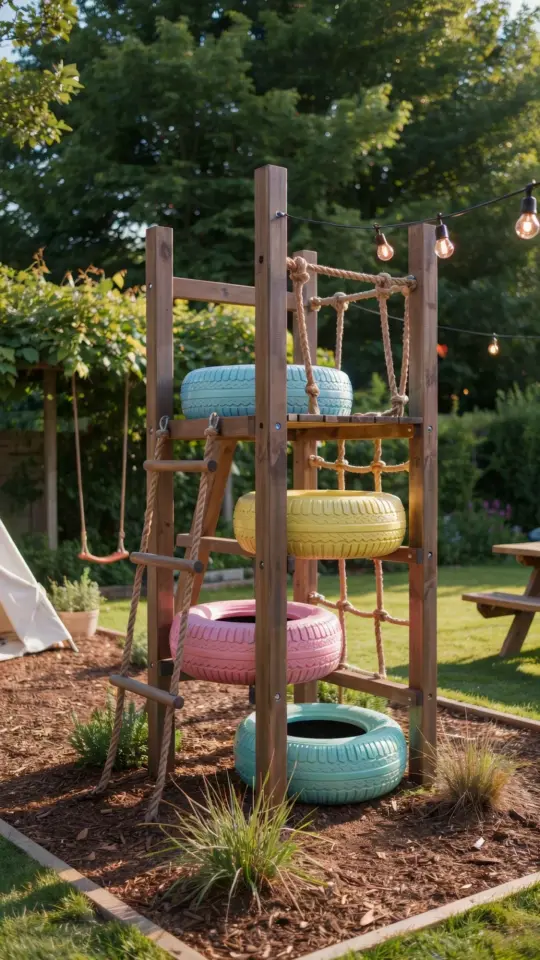
You do not need to build a giant timber fortress. You can create a simple circuit with things you already own. A balance beam made from a fallen log or a row of pavers. A jumping station with some old tires or a chalk-drawn hopscotch grid.
Use the ground to guide them. Chalk arrows on the patio can map out the course, and they will follow it faithfully. Add a cheap rope ladder over a branch or a slackline if you are feeling fancy, though I doubt you need to spend that much. The goal is free-flowing gross motor play, not a scheduled bootcamp. Let them run the circuit backward, forward, and with a stuffed animal tucked under their arm.
A Cozy Hideout That Is Actually Hidden
Kids want to feel hidden. It is a power trip for them to have a space that adults technically cannot fit into. A simple bamboo teepee, a few leaning branches, or a curtained-off section under the deck works perfectly.
The secret here is to make it feel secret. If you put it right next to the patio in full view of your lounge chair, it loses its magic. Tuck it in a corner, behind a bush, or against the side of the house.
Throw a tarp over the top for light rain and toss in a couple of beanbags. Give them some battery-operated fairy lights. They will guard that space with their lives. And you will realize that the best kid outdoor play ideas are the ones that give children the illusion of total independence, even if you have a clear sightline from the kitchen window. It is a win-win.
A Defined Spot for Wheeled Things That Does Not Cross the Tomato Patch
Boundaries are huge. Fewer conflicts happen when kids know exactly where the bikes and scooters are allowed to go. At the same time, they need to know where they are not allowed to go, otherwise you spend the whole afternoon screaming “not the flowers!” from the porch.
Use a concrete pad or a gravel path to designate the “road.” If you do not have one, create a chalk-drawn track on the grass. It fades away, but kids remember the layout. It is like they have a mental map.
Add a “parking lot” using a wooden pallet or a line of paint. This encourages them to put the stuff away, or at least it gives them a specific place to forget it. It is not about being tidy, it is about making the rules of the yard clear. Clear rules mean more independent play and less asking you for permission on every single turn. That is the freedom they crave.
Not every idea needs to be a construction project. Sometimes the best thing you can do is look at your yard from a height of three feet. Crouch down, see what the grass looks like from their level, and ask yourself if you would want to play here. Then, just leave out the good stuff and walk away.
The Final Verdict on Play Areas That Work
The common thread through all these spaces is that they are low-stakes and high-freedom. They invite interaction instead of just observation. Great outdoor play areas are not about the price tag or the aesthetic; they are about the invitation to do something, anything, without being corrected.
Your backyard should feel like a Yes place. Not a space full of expensive features you stress about protecting, but a scruffy, flexible environment that meets your kid where they are developmentally.
So take a critical look at your own yard this weekend. What gets ignored? What gets used? Rip out the stuff that is failing and replace it with just one of these themes. The tire swing can wait. The mud pit cannot. I would love to know which of these ideas your kids end up obsessed with, drop a comment and let me know what chaos ensues.
Leave a Comment