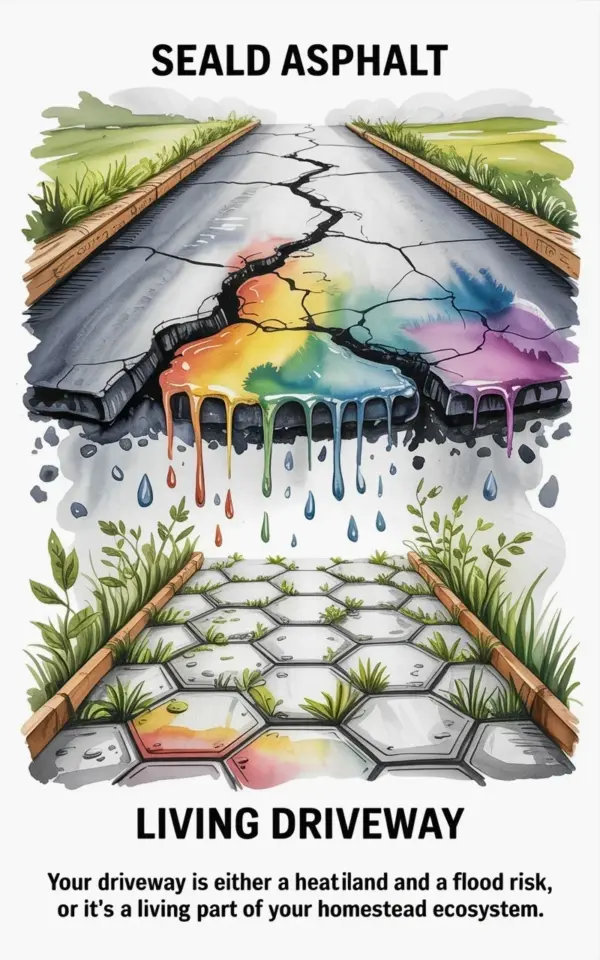
If you have been scrolling through Pinterest for driveway ideas, you have probably seen that watercolor comparison. It is striking. Top half: sealed asphalt, cracked wide open, rainbow oil stains bleeding into the fissures, steam curling up like the surface is sighing in defeat. Bottom half: a living driveway with hexagonal pavers, tiny green plants tucked between them, rain droplets falling fresh and clean. Honestly, that image stuck with me because it shows the two paths so clearly. And if you are researching a living driveway for your own property, you already know which one calls to you. But here is the thing. The pretty picture hides a few real-world mistakes that people make when trying to go from cracked asphalt to a green, permeable path. I want to walk you through those mistakes so you skip the frustration and get the garden path of your dreams.
The Sealed Asphalt Trap: Why Cracks and Stains Are Almost Inevitable
Ok so sealed asphalt looks clean for a year. Maybe two if you are lucky. Then it starts talking to you in cracks. And not the nice kind of crackle you get from a fireplace. Deep fissures that collect water, freeze, and widen. The watercolor in that Pinterest image shows rainbow-colored oil spots, and that is not an exaggeration. I have seen driveways that look like abstract art, except nobody wants to pay for that kind of gallery. Sealing asphalt is a common mistake because people think it stops the problems. It does not. It just delays them while trapping moisture underneath. The steam rising in the illustration? That is moisture escaping from below, exactly what happens when the sealant fails and the ground heats up. My neighbor resealed his asphalt every single spring. By the fourth year it was a patchwork of tar patches and tire marks. He spent more on sealer than I spent on a whole set of permeable pavers.
Permeable Pavers: Not Just for Looks, but for Function
Let me be honest. When I first saw hexagonal pavers with plants growing between them, I thought it was a gardening gimmick. Something for a fancy backyard, not a real driveway. But then I looked at the engineering. Those gaps between the hexagons allow rainwater to soak straight into the ground, which means no runoff flooding your lawn, no pooling puddles that freeze into ice sheets. And the plants? They absorb heat, so the surface stays cooler on a summer afternoon. Here is a mistake I see a lot: people buy any old concrete paver and call it permeable. Not true. You need pavers specifically designed with wide enough joints for both water flow and plant roots. If the gaps are too narrow, the plants suffocate and water just runs off the edge. Too wide and the pavers shift under car tires. The hexagonal shape helps lock them together, like a honeycomb. But you still need a proper base layer of crushed stone, not sand, or the whole thing sinks within two winters. I learned that the hard way when a friend’s “living driveway” turned into a wavy mess after one snow plow.
The Plant Factor: What to Put Between the Hexagons
Honestly, people get this wrong more than any other part. They see the watercolor with those cute green plants and think, “I will just throw some seeds in there.” Then they end up with dandelions or mint. Mint, specifically, is a nightmare. It spreads underground, climbs through the gaps, and starts popping up in your lawn twenty feet away. I once tried a creeping mint variety for a garden path. Not gonna lie, I spent an afternoon digging out runners for years. So what works? Low-growing, drought-tolerant, foot-friendly plants. Creeping thyme is my favorite. It smells amazing when you walk on it, your tires do not kill it because it is tough, and it stays short. Irish moss (Scotch moss) works too, but it needs more water. Sedum varieties like ‘John Creech’ or ‘Angelina’ handle heat and dry spells. Another common mistake is planting something that needs full sun when your driveway is shaded half the day. Pick plants that match your light conditions. And do not forget about winter. Some plants die back and leave bare mud. Thyme stays green and evergreen in mild climates. If you live where it snows, the plants go dormant anyway, but the pavers still function fine. A little dead growth mixed with snow is not a big deal.
Installation Mistakes That Ruin a Living Driveway
I have seen beautiful hexagonal pavers installed wrong, and within a year they look like a failed jigsaw puzzle. Here are the biggest screw-ups to avoid:
- Skimping on the base depth. Most driveways need at least eight inches of compacted gravel base. People cut it to four inches because they want to save money. Then the pavers shift under the weight of a car on a hot day. You get dips and humps.
- Forgetting about drainage slope. Even though water soaks through the joints, you still need a slight slope (1-2%) so water does not pool near your house foundation. I have a friend who installed his living driveway perfectly flat. After a heavy rain, the middle section stayed wet for three days. Moss grew. Not the cute kind, the slippery slime kind.
- Using the wrong joint material. Sand washes out. Fine gravel (like 1/8 inch crushed stone) stays put. But people fill the gaps with cheap play sand, and the first storm scours it away. Then the plants have nothing to grip and the pavers rock.
- Planting too soon. Give the base and pavers a few weeks to settle. Run your car over them, let rain compact the joints, then plant. If you plant immediately, the roots get disturbed when the pavers shift, and half the plants die.
- Ignoring utility access. You have to cut through a living driveway differently than asphalt. Plan for future pipe repairs or electric cable runs. Leave a few pavers unplanted and marked so you can lift them without killing the whole section.
That last one is oddly specific, I know. But my uncle had to rip up a whole garden path to fix a water line, and the plants never fully recovered. He called me complaining about “that stupid green driveway.” It was not stupid. He just did not think ahead.
Sustainability vs. Maintenance: The Real Trade-Off
A living driveway is more sustainable, no question. Permeable surfaces reduce stormwater runoff, recharge groundwater, and cut the urban heat island effect. But here is the trade-off: maintenance. Asphalt you ignore until it cracks, then you patch it. With a living driveway, you need to weed every couple of weeks during growing season. Not full-on gardening, just pulling out the aggressive weeds that sneak in between the thyme. You also need to top up the gravel in the joints once a year. And if a plant dies, you replace it. That might sound like a lot. But compare it to resealing asphalt every two years, or paying someone to fill cracks that keep widening. Honestly, I would rather spend ten minutes pulling a few weeds than scrubbing oil stains off blacktop or breathing in hot tar fumes. The maintenance is different, not necessarily more. It is just hands-on. A sustainable garden path fits a person who enjoys a little outdoor interaction. If you want zero effort, stick with concrete. But then you lose the aliveness that the watercolor captures so perfectly.
Which Vibe Wins? A Practical Side-by-Side
Look at that Pinterest comparison again. The sealed asphalt side is all cracked, stained, steaming. The living driveway side is wet with clean rain, green between the hexagons, cool and quiet. I have driven on both. Asphalt feels hot, hard, and unforgiving. A living driveway with permeable pavers feels softer underfoot, the plants brush your ankles, and on a hot day it is noticeably cooler. There is a sensory difference that pictures cannot fully show. But you have to be honest with yourself about your climate, your budget, and your willingness to do seasonal upkeep. If you live somewhere with heavy clay soil that drains poorly, you need a deeper gravel base and possibly a French drain underneath. That adds cost. If you park a heavy truck on it every day, make sure your pavers have a thickness of at least 80mm. And if you have kids who drag bikes across the surface, the plants might take a beating. But they usually bounce back. Creeping thyme is tough like that. So which vibe do you prefer? A cracked, stained, hot surface that eventually needs replacement, or a living, breathing surface that gets better as the plants fill in? I know my answer. I have a small patch of hex pavers by my back gate now, and every time I step on it, the smell of crushed thyme makes me smile. That alone is worth skipping the asphalt.
#livingdriveway #drivewayideas #gardenpath #permeablepavers #sustainablegarden
Leave a Comment